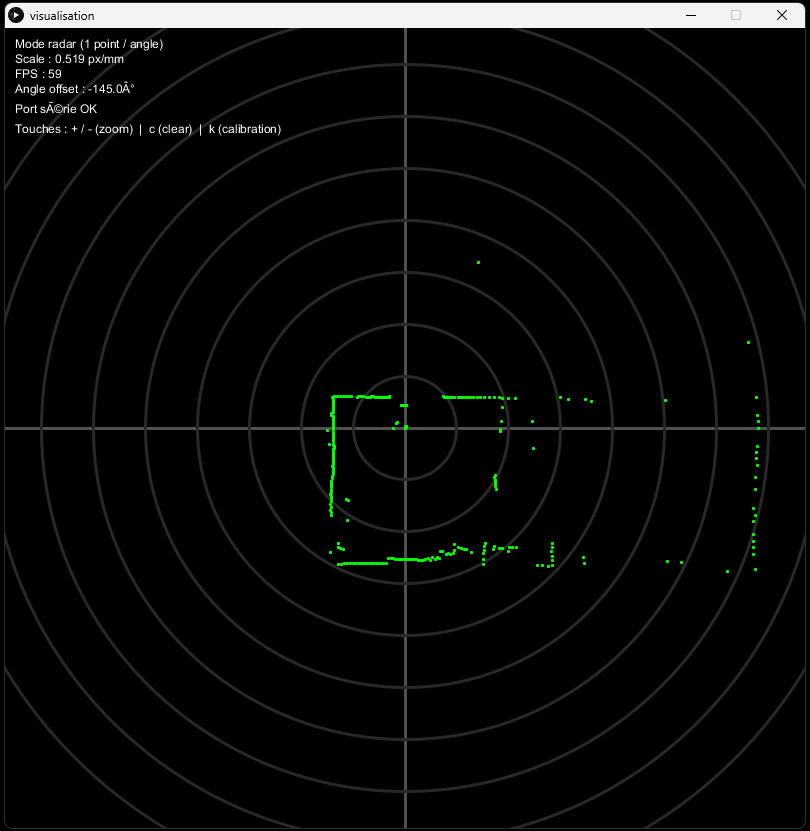
¶ RP-Lidar 360°
Lidar 2D
Evolutions possibles:
- Etablir une connexion WiFi entre le Lidar et le PC processing 3
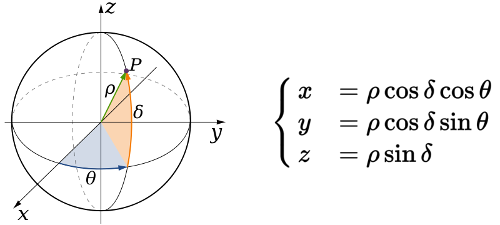
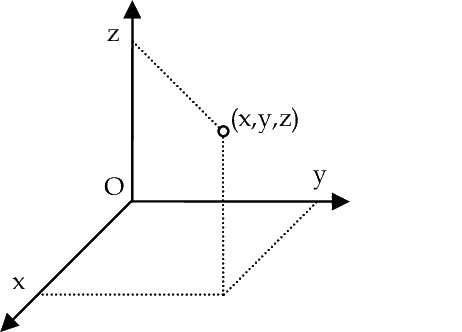
- ajouter une mécanique perméttant d'intégrer le troisième axe et avoir une rprésentation 3D de l'espace
 |
 |
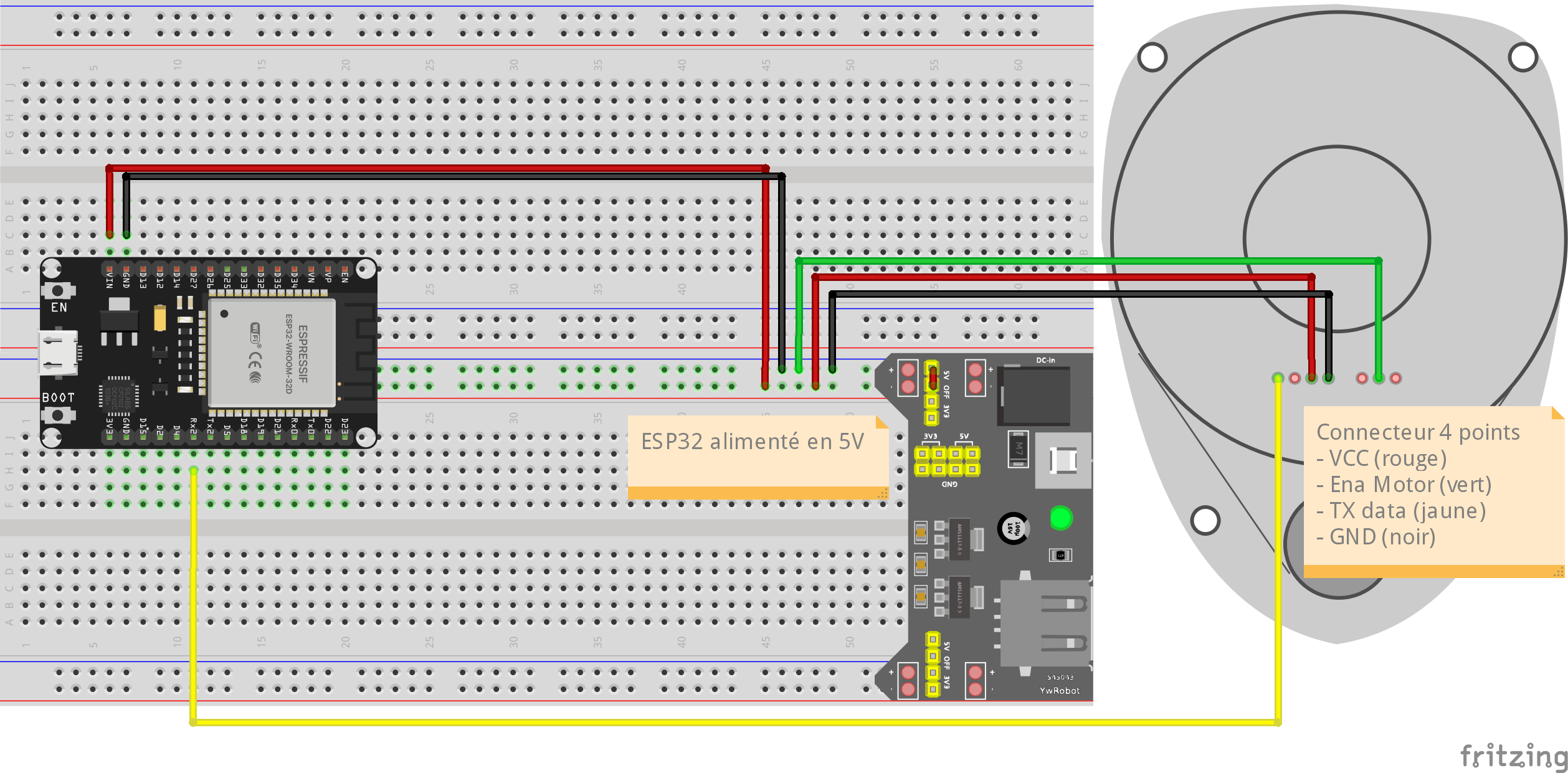
¶ Rôles des 4 fils
| Couleur | Fonction | Direction | Commentaire |
|---|---|---|---|
| Rouge | +5 V | — | Alim moteur + électronique |
| Noir | GND | — | Masse |
| Jaune | TX du LiDAR → micro | Sortie | Données série (230400 bauds) |
| Vert | MOTOR_EN / ENABLE | Entrée | Active la rotation (HIGH = ON) |
¶ Arduino
/******************************************************************
 * LiDAR X-WPFTB-V2.x - ESP32 WROOM
 * Envoi des points en XY sur le port USB :
 *   "P x y\n"  (x,y en cm, entiers)
 ******************************************************************/

static const int LIDAR_RX = 16;   // LiDAR TX -> ESP32 RX2
static const int LIDAR_TX = 17;   // (pas utilisé)
static const int LIDAR_EN = 4;    // fil vert ENABLE moteur

static const int FRAME_SIZE = 60;
uint8_t frameBuf[FRAME_SIZE];
int frameIndex = 0;
bool synced = false;

void setup() {
  Serial.begin(115200);          // <-- COM20 à 115200 dans Processing
  delay(1000);
  Serial.println("=== LiDAR X-WPFTB - ESP32 ===");

  pinMode(LIDAR_EN, OUTPUT);
  digitalWrite(LIDAR_EN, HIGH);

  Serial2.begin(230400, SERIAL_8N1, LIDAR_RX, LIDAR_TX);
}

// ---------- Décodage & envoi XY ----------
void decodeFrame(uint8_t* buf) {
  uint8_t type    = buf[2];
  uint8_t dataLen = buf[3];

  if (type != 0x07 || dataLen != 0x0C) {
    return; // on n'utilise que les trames de mesures
  }

  uint16_t startRaw      = buf[6] | (uint16_t(buf[7] & 0x7F) << 8);
  int16_t  startCode     = int16_t(startRaw) - 0x2000;
  float    startAngleDeg = startCode / 64.0f;

  uint16_t endRaw        = buf[56] | (uint16_t(buf[57] & 0x7F) << 8);
  int16_t  endCode       = int16_t(endRaw) - 0x2000;
  float    endAngleDeg   = endCode / 64.0f;

  const int N = 12; // 12 points
  float delta = endAngleDeg - startAngleDeg;
  if (delta < -180.0f) delta += 360.0f;
  if (delta >  180.0f) delta -= 360.0f;
  float step = (N > 1) ? (delta / (N - 1)) : 0.0f;

  for (int i = 0; i < N; i++) {
    int base = 8 + i * 4;

    uint8_t dL = buf[base + 0];
    uint8_t dH = buf[base + 1];

    uint16_t distCode = (uint16_t(dH) << 8) | dL;
    float dist_mm = distCode * 0.1f;

    float angleDeg = startAngleDeg + i * step;
    if (angleDeg < 0) angleDeg += 360.0f;
    if (angleDeg >= 360.0f) angleDeg -= 360.0f;

    // On envoie "D angle distance"
    Serial.print("D ");
    Serial.print(angleDeg, 2);
    Serial.print(' ');
    Serial.println(dist_mm, 1);
  }
}
// ---------- Boucle de synchro ----------
void loop() {
  while (Serial2.available()) {
    uint8_t b = Serial2.read();

    if (!synced) {
      if (frameIndex == 0) {
        if (b == 0x55) {
          frameBuf[frameIndex++] = b;
        }
      } else if (frameIndex == 1) {
        if (b == 0xAA) {
          frameBuf[frameIndex++] = b;
          synced = true;
        } else {
          frameIndex = 0;
        }
      }
      continue;
    }

    frameBuf[frameIndex++] = b;

    if (frameIndex == FRAME_SIZE) {
      decodeFrame(frameBuf);
      frameIndex = 0;
      synced = false;
    }
  }
}
¶ Processing
add_library('serial')
from processing.serial import Serial
import math

# --- Paramètres ---

# distance par angle (0..359), en mm
dist_by_angle = [0.0] * 360

scale = 0.2          # pixels par mm
ANGLE_OFFSET = -145.0 # offset initial (à ajuster)
lidarPort = None
buffer = ""          # buffer de réception série


def setup():
    global lidarPort
    size(800, 800)
    background(0)
    frameRate(60)

    ports = Serial.list()
    print("Ports disponibles :", ports)

    # chez toi, COM20 est à l'index 1
    if len(ports) > 1:
        portName = ports[1]
        print("Ouverture du port :", portName)
        try:
            lidarPort = Serial(this, portName, 115200)
            # on lit manuellement dans draw()
        except Exception as e:
            print("Erreur à l'ouverture du port série :", e)
            lidarPort = None
    else:
        print("Pas assez de ports détectés.")
        lidarPort = None


def draw():
    global buffer

    # 1) Lecture du port série
    if lidarPort is not None:
        while lidarPort.available() > 0:
            c = chr(lidarPort.read())
            buffer += c
            if c == '\n':
                msg = buffer.strip()
                buffer = ""
                # debug si besoin :
                # print("RAW:", repr(msg))
                handleMessage(msg)

    # 2) Affichage radar
    background(0)

    translate(width/2, height/2)

    # axes
    stroke(80)
    line(-width/2, 0, width/2, 0)
    line(0, -height/2, 0, height/2)

    # cercles 1m / 2m / 3m
    noFill()
    stroke(40)
    for d in range(10):
        ellipse(0, 0, 2*d*100*scale, 2*d*100*scale)

    # points : 1 par angle
    stroke(0, 255, 0)
    strokeWeight(3)
    for ang in range(360):
        d = dist_by_angle[ang]
        if d <= 0:
            continue
        a_rad = math.radians(ang)
        x = -d * math.cos(a_rad) * scale
        y = -d * math.sin(a_rad) * scale
        point(x, y)

    # overlay texte
    resetMatrix()
    fill(255)
    text("Mode radar (1 point / angle)", 10, 20)
    text("Scale : %.3f px/mm" % scale, 10, 35)
    text("FPS : %d" % frameRate, 10, 50)
    text("Angle offset : %.1f°" % ANGLE_OFFSET, 10, 65)
    if lidarPort is None:
        text("Port série NON ouvert", 10, 85)
    else:
        text("Port série OK", 10, 85)
    text("Touches : + / - (zoom)  |  c (clear)  |  k (calibration)", 10, 105)


def handleMessage(msg):
    global dist_by_angle, ANGLE_OFFSET

    if not msg:
        return

    # on attend "D angle distance"
    if not msg.startswith('D'):
        # autres messages éventuels
        # print("DBG:", msg)
        return

    parts = msg.replace(',', ' ').split()
    if len(parts) < 3:
        # print("DBG (format invalide):", msg)
        return

    try:
        angle_deg = float(parts[1])
        dist_mm   = float(parts[2])

        # filtrage simple : ignore distances nulles ou ridicules
        if dist_mm < 1:
            return

        # applique l'offset d'angle
        angle_corr = (angle_deg + ANGLE_OFFSET) % 360.0

        # arrondi à l'angle entier le plus proche
        idx = int(round(angle_corr)) % 360
        dist_by_angle[idx] = dist_mm

    except Exception as e:
        print("Parse error:", msg, "->", e)


def calibrate():
    """Calibre ANGLE_OFFSET en prenant le point le plus proche comme 'devant'."""
    global ANGLE_OFFSET, dist_by_angle
    minDist = 1e9
    bestAng = 0
    for ang in range(360):
        d = dist_by_angle[ang]
        # on ignore les distances trop faibles ou nulles (bruit)
        if d > 50 and d < minDist:
            minDist = d
            bestAng = ang
    ANGLE_OFFSET = -float(bestAng)
    print("Calibration OK -> ANGLE_OFFSET =", ANGLE_OFFSET, " (minDist =", minDist, "mm)")


def keyPressed():
    global scale, dist_by_angle
    if key in ['c', 'C']:
        dist_by_angle = [0.0] * 360
    elif key == '+':
        scale *= 1.1
    elif key == '-':
        scale /= 1.1
    elif key in ['k', 'K']:
        calibrate()